Explainer · · Scrutable team
The Bitcoin halving: what four examples can and cannot tell you
Every four years or so, the number of new Bitcoin created is cut in half. Past halvings were followed by big rises. Here is why that history is weaker evidence than it looks.
Bitcoin has a fixed supply: only 21 million will ever exist. New coins are created as a reward for the computers that keep the network running, and about every four years that reward is cut in half. This is "the halving".
Bitcoin that will ever exist
halvings so far: 2012, 2016, 2020, 2024
Why people think it matters
If the flow of new coins halves while demand stays the same, the price should rise. And after each past halving, Bitcoin did rise a lot within about 18 months.
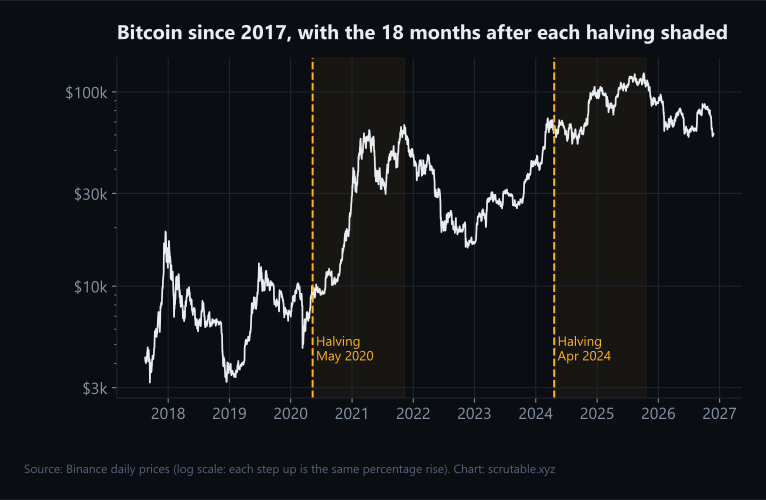
Why the history is weaker than it looks
- Four examples is a tiny sample. You would not trust a medicine tested on four people.
- Other things happened at the same time. The 2020 halving came alongside huge money printing during the pandemic. It is hard to say which caused what.
- Each rise was smaller than the last. The new supply is now a tiny fraction of the coins already out there, so each halving changes less.
- Everyone knows the date. A predictable event is partly priced in before it happens.
How to think about it
The halving is a real, permanent change to Bitcoin's supply. It is not a guaranteed price event. Treat any chart that "proves" the next halving rally with care, and look at what else is moving the market: interest rates, stocks and fund flows.
More in our coin basics guide.
This article explains; it is not advice to buy or sell anything.
More articles
- We tested 30 popular trading signals on five years of crypto prices. Here is what held up
- Does buying the dip work? Our test says it feels better than it pays
- What a Fed rate cut actually does to Bitcoin
- Liquidations (爆倉) explained: why crypto can fall 10% in minutes
See today's market in plain words Learn the basics