Explainer · · Scrutable team
Funding fees in plain words: what they tell you about the crowd
Every few hours, one side of the crypto futures market pays the other. Who pays, and how much, is one of the clearest signs of how crowded a bet has become.
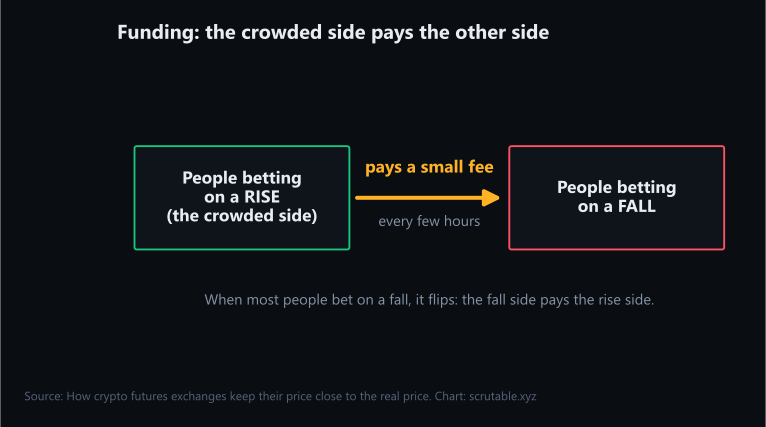
Crypto futures that never expire ("perpetuals") need a way to stay close to the real price of the coin. The answer is a small fee that one side pays the other every few hours, usually every eight. It is called the funding fee (資金費率).
Who pays whom
- Positive funding: most traders are betting on a rise. They pay the ones betting on a fall.
- Negative funding: most are betting on a fall. They pay the ones betting on a rise.
- The bigger the fee, the more lopsided the crowd.
how often most exchanges charge funding
a large fee means many people are on the same side
Why it matters even if you never trade futures
Funding is a live poll of what borrowed money is betting on. When almost everyone is on one side and paying a lot to stay there, a small move the other way can trigger a chain of forced closes.
What our tests found
We checked whether it pays to take breakout trades on the side that is paying less. It helped a little, and it was the only filter that improved results in all three of our test periods. But the edge was small and nearly gone in the last 12 months. Crowded bets can stay crowded for a long time.
Where to see it
Who is betting what shows the funding fee for every major coin in plain words, with how far you can trust it. The plain-words guide explains the other futures terms.
This article explains; it is not advice to buy or sell anything.
More articles
- We tested 30 popular trading signals on five years of crypto prices. Here is what held up
- Does buying the dip work? Our test says it feels better than it pays
- What a Fed rate cut actually does to Bitcoin
- Liquidations (爆倉) explained: why crypto can fall 10% in minutes
See today's market in plain words Learn the basics