Explainer · · Scrutable team
Stablecoins explained: what USDT is, and what can go wrong
USDT and USDC are the cash of the crypto world: coins built to always be worth one US dollar. Here is how they keep that promise, and the times it has wobbled.
When you buy crypto on an exchange, you usually do not pay with dollars directly. You pay with USDT or USDC: coins designed to always be worth exactly one US dollar. They are called stablecoins (穩定幣).
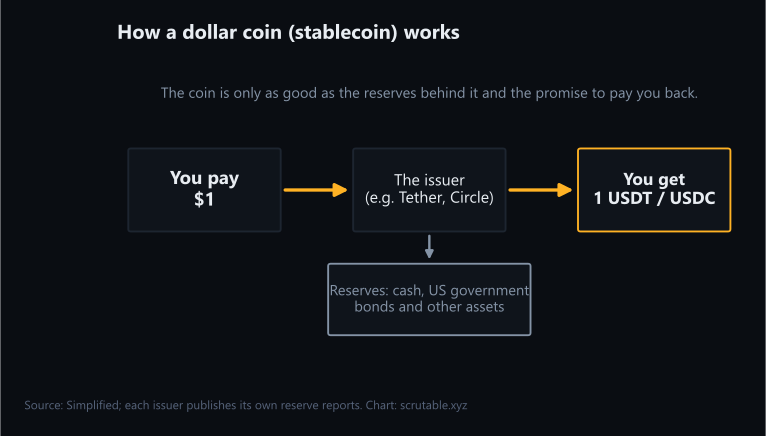
How they stay at $1
The big ones, USDT (from Tether) and USDC (from Circle), are backed by reserves: cash, short-term US government bonds and similar assets. In theory, for every coin out there, there is a dollar's worth of something in reserve, and big holders can swap coins back for dollars.
what a stablecoin is meant to be worth, always
biggest: USDT (Tether) and USDC (Circle)
When the promise wobbled
- A coin with no real reserves broke completely. In May 2022 TerraUSD, a stablecoin held at $1 by an algorithm instead of reserves, lost its $1 value within days. Together with its sister coin Luna, about $40 billion of value disappeared, and funds that held them went down too. You can see what that did to Bitcoin on our history page.
- Even backed coins can slip. In March 2023, when a US bank holding part of USDC's reserves failed, USDC briefly traded well below $1 before recovering.
What to check
- What backs it? Cash and government bonds are safer than algorithms or other crypto.
- Does the issuer publish regular reserve reports? Read them, or at least check that they exist.
- Where is it held? A stablecoin on an exchange is also exposed to that exchange.
Stablecoins are useful. They are also a promise from a company, not a bank deposit. Our coin basics guide covers the other terms.
This article explains; it is not advice to buy or sell anything.
More articles
- We tested 30 popular trading signals on five years of crypto prices. Here is what held up
- Does buying the dip work? Our test says it feels better than it pays
- What a Fed rate cut actually does to Bitcoin
- Liquidations (爆倉) explained: why crypto can fall 10% in minutes
See today's market in plain words Learn the basics